
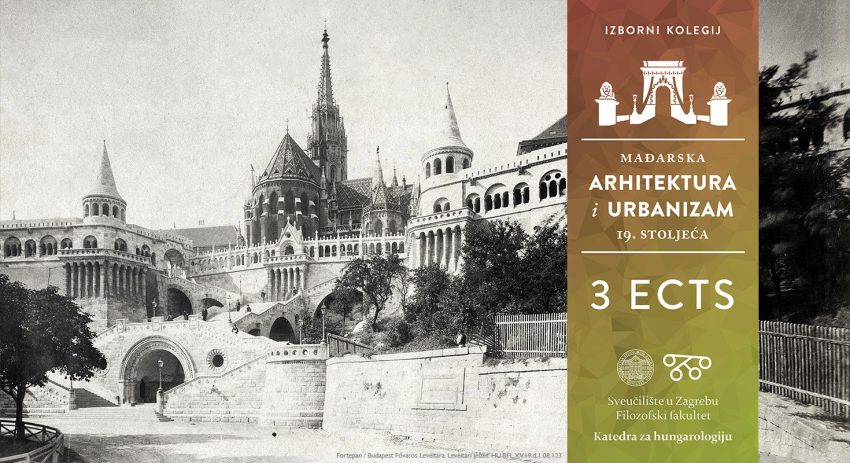
In the summer semester of the 2025/2026 academic year, the elective MA-level course Architecture and Urban Planning in Nineteenth-Century Hungary will once again be offered at the Faculty of Humanities and Social Sciences, University of Zagreb, within the Chair of Hungarian Studies at the Department of Hungarian Studies and Turkology. The course is taught by the architect and conservation specialist Boris Dundović, while the course convenor is Associate Professor Sándor Bene, PhD. The course carries 3 ECTS credits and, owing to its status as an external elective, is also open to students enrolled in other graduate programmes at the University of Zagreb.
From this academic year onwards, the course is also offered as an open course within the Faculty’s Lifelong Learning Programme and is open to all interested participants. Further information is available via the link.
Teaching will be organised in double-period sessions on Wednesdays from 3.30 to 5.00 p.m. at Ivana Lučića Steet 3, in lecture room A-315 (3rd floor). The introductory lecture will be held on 25 February 2026, in accordance with the summer semester timetable.
The course examines the history and conceptual frameworks of Hungarian architecture and urban planning from the late eighteenth century to the Treaty of Trianon in 1920. The so-called “long nineteenth century” is divided into four phases, distinguished by the heightened intensity of particular stylistic tendencies: the architecture and urban planning of Neo-Classicism, early Historicism (Romanticism), high Historicism, and the period around the turn of the twentieth century, marked by Eclecticism and Art Nouveau tendencies. The course presents the principal protagonists and key examples of architectural production that illustrate the architectural and urban discourse of the period. It also addresses the impact of contemporary Hungarian architecture and urban planning on the Croatian territories. In this way, the course offers a foundational synthesis and principal interpretative framework for understanding the built environment of nineteenth-century Hungary.
The principal aim of the course is to familiarise participants with the development of the built environment during the period of the most intensive formation of the identity of a cultural sphere that also left a profound mark on Croatian history. Participants are introduced to the categories and typologies of nineteenth-century architecture and urban planning, as well as to their specific characteristics in relation to coinciding social, economic, political, and cultural developments. The course further highlights the particular influence of Hungarian tendencies on the development of Croatian towns and cities in this period and addresses the subject of Croatian-Hungarian connections in architecture. Participants thereby acquire fundamental knowledge of the history of nineteenth-century Hungarian architecture and urban planning, together with the ability to undertake comparative analysis of the themes and case studies addressed in the course.
Further information is available on the website of the Chair of Hungarian Studies at the Faculty of Humanities and Social Sciences and via Instagram.